

Sand or Replace? How to Tell Whether an Old Wooden Floor Is Worth Saving
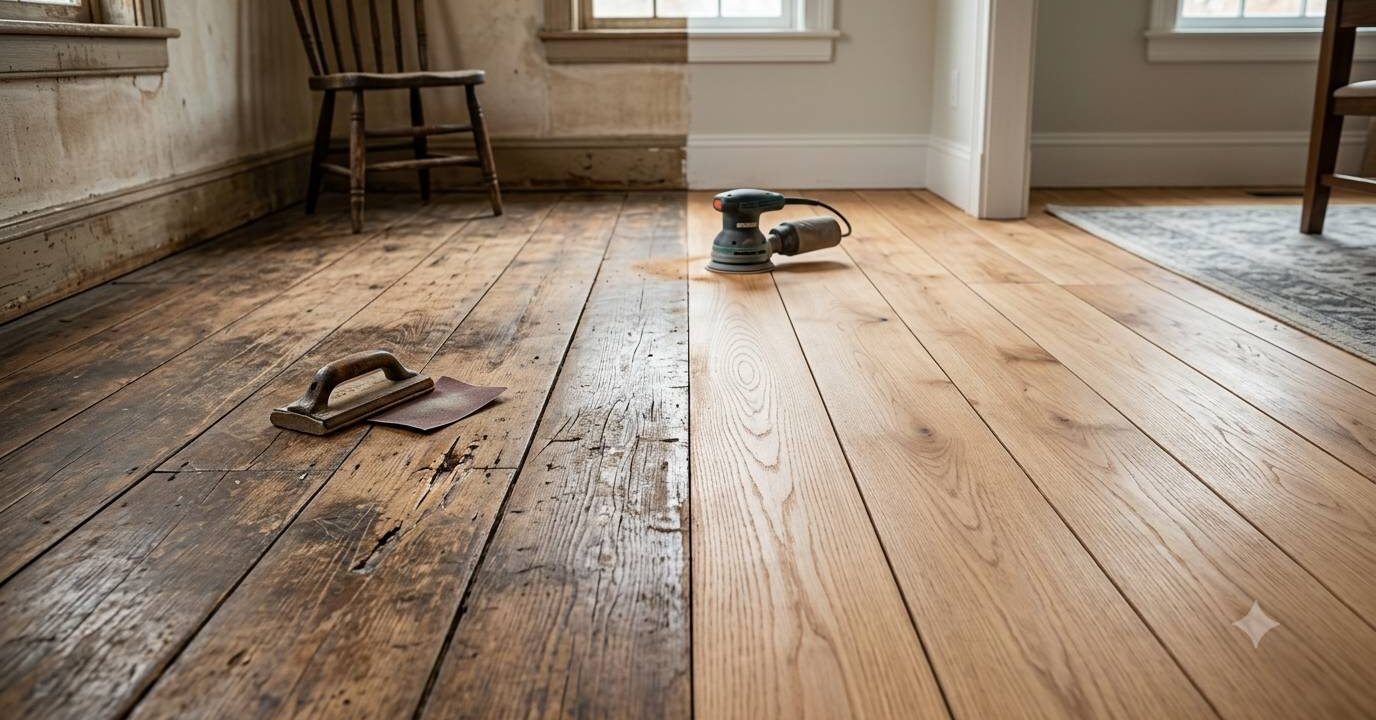
Lift a tired carpet in a Victorian terrace and there is a good chance you will find pine or oak boards underneath: grey with dust, peppered with tack holes, and streaked with the remains of a varnish somebody applied in 1978. The instinct is to skip it and order something new. That is usually the wrong call. A floor that looks beyond saving on a Sunday afternoon can look remarkable by the end of the week, for a fraction of the cost of replacement and without the embodied carbon of new timber.
The useful question is not “how do I sand this?” but “how much wood have I got left to work with?”
Answer that honestly and every other decision follows. It is the first thing a specialist in wood flooring restoration essex-wide will check before quoting, and it is something a homeowner can assess in about ten minutes with a torch and a steel rule.
Start with the arithmetic of the wear layer
Every sand and refinish spends a small amount of timber that never grows back. A professional cut removes roughly 0.5mm to 1mm of wood, and the floor has only so much to give.
With solid boards, the sandable zone is everything above the tongue. An 18mm to 20mm solid board typically leaves 5mm or 6mm of usable timber above the joint, which is enough for five to eight refinishes across the life of the floor. Since most period floors have already been sanded once or twice, it is worth checking rather than assuming. A quick indicator: if nail heads sit proud of the surface, or the tongue is visible in a gap, previous work has already taken the boards down and there may be less room than the thickness suggests.
Engineered boards demand more care, because only the top hardwood layer can be touched. Wear layers on the UK market range from around 0.5mm to 6mm. Below 2mm, machine sanding is not worth the risk; those floors should be screened and recoated instead. At 3mm you might get two or three refinishes, and at 6mm the board behaves much like solid oak. Lift a board at a threshold or an air vent, or look at a cut edge in a doorway, and measure it before anyone starts a machine.
Deal with moisture before you deal with the surface
Sanding a floor that is still moving is money poured away. Cupping, where board edges sit higher than the centres, points to moisture arriving from below: a blocked airbrick, a failed damp-proof course, or a leaking pipe. Wide winter gaps that close in summer point the other way, towards very dry indoor air.
British guidance for continuously heated homes puts timber moisture content at roughly 9 to 11 per cent, with indoor relative humidity between 40 and 60 per cent. Underfloor heating and modern airtight construction can push winter humidity well below that range. A calibrated hygrometer costs under twenty pounds and is the cheapest insurance a wood floor owner can buy. Fix the cause, let the boards settle, and only then sand. Skip that step and the new finish will crack along the joints within a season.
Repair sympathetically, then choose the finish for the room
Splits, woodworm damage and boards butchered by plumbers can be cut out and replaced, ideally with reclaimed timber of matching species and grain so the patch disappears once the floor is finished. For gaps in older pine floors, tapered slivers of matching timber glued into the joint outlast flexible filler, which tends to work loose as the boards move through the year.
On finishes, the trade-off is simple. Hardwax oil gives a natural, low-sheen look and can be repaired in patches, which suits kitchens and hallways where damage happens locally, though it needs topping up every few years in busy areas. Two-component water-based lacquer is harder wearing and better suited to commercial floors and busy family homes, but when it wears through in traffic lanes the whole area has to be recoated.
Whichever you choose, a screen and recoat every few years refreshes the surface without spending any of the wear layer. Add felt pads to furniture, a decent doormat at each entrance to catch the grit that does most of the scratching, and a pH-neutral cleaner rather than a steam mop.
The verdict
Most old wooden floors are worth saving. Measure what you have, sort out the moisture, repair before you refinish, and pick a finish that matches how the room is actually used. Do that and a floor already a century old will comfortably see out another generation.










Leave a Comment